Sports Turf Cleaning and Maintenance for San Diego Facilities
Artificial turf sports fields are a major investment for San Diego schools, parks, recreation centers, and private athletic facilities. These surfaces endure intense, concentrated use that far exceeds residential wear patterns. Athletes running, cutting, sliding, and falling on the surface hour after hour create demands that require professional maintenance to ensure safety, performance, and longevity. A well-maintained sports field protects athletes and delivers consistent playing conditions throughout its lifespan.
Sports Field Specific Needs
Sports turf differs from landscape turf in several important ways. The fibers are typically longer and denser to provide cushioning for athletic activity. The infill layer is deeper to absorb impact and reduce injury risk. The surface must provide consistent traction and ball response across the entire playing area. Any variation in surface conditions, whether from infill displacement, fiber matting, or contamination, can affect play quality and increase injury risk.
San Diego's climate creates additional considerations for sports turf. Year-round outdoor sports seasons mean the fields receive constant use without an off-season for recovery and intensive maintenance. UV exposure from our abundant sunshine degrades fibers faster than in less sunny climates. Summer heat can push surface temperatures to levels that require active management to protect athletes.
Safety Requirements
Athlete safety is the paramount concern for sports turf maintenance. Proper infill depth and distribution are critical for impact absorption. The industry standard for sports turf is a G-max rating that measures the hardness of the surface when impacted. As infill compacts or depletes, the G-max rating increases, meaning the surface becomes harder and less capable of absorbing the force of falls and collisions.
Regular G-max testing should be part of every sports field maintenance program. Testing is typically performed annually, with additional tests after any maintenance that significantly alters the infill layer. If G-max ratings approach unsafe levels, immediate infill replenishment and decompaction are required before the field can be used for athletic activity.
Traction testing ensures the surface provides adequate grip without being excessively sticky. Inconsistent traction caused by uneven infill distribution or contamination increases the risk of ankle and knee injuries. Maintaining uniform infill levels across the entire playing surface is essential for consistent traction.
Performance Maintenance
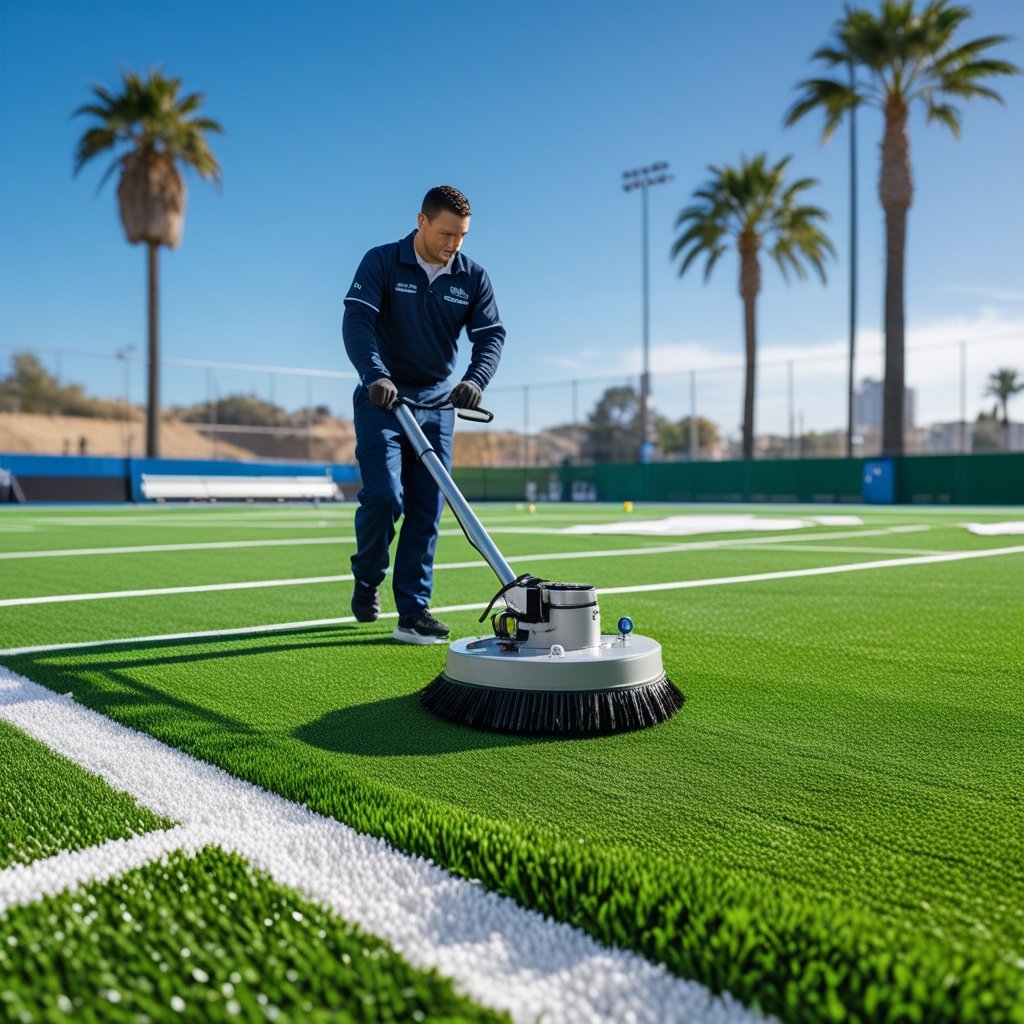
Beyond safety, sports turf maintenance preserves the playing characteristics that athletes and coaches expect. Ball roll, ball bounce, and surface speed should remain consistent across the field and season to season. Power brushing maintains uniform fiber height and infill distribution that deliver consistent ball interaction. Grooming removes debris that can alter surface characteristics in localized areas.
Line markings on sports fields need periodic maintenance or repainting. Cleaning around and over painted lines requires care to avoid damaging the markings while still maintaining the turf beneath them.
Infill Management
Sports field infill requires more active management than landscape turf. High-intensity use displaces infill from goal areas, sidelines, center field, and other high-traffic zones. Players' cleats grip and move infill with every step. Regular infill redistribution using specialized equipment moves material from low-use areas back to depleted zones.
Infill replenishment for sports fields is typically needed annually, compared to every two to three years for residential turf. The investment in infill maintenance directly protects athlete safety and field performance. Deferred infill replenishment leads to increased injury risk, degraded play quality, and accelerated fiber damage from inadequate support.
Professional Service Schedules
A comprehensive sports turf maintenance program for San Diego facilities includes weekly grooming and debris removal during active seasons, monthly power brushing and infill redistribution, quarterly deep cleaning and sanitization, semi-annual infill depth measurement and replenishment as needed, and annual G-max and traction testing with full condition assessment. Facilities with year-round use should maintain this schedule throughout the year. Facilities with seasonal use should perform intensive restoration before each season begins and a comprehensive deep clean at the end of each season to prepare the field for the next use period.