Enzyme Treatments: The Science Behind Turf Odor Elimination
When it comes to eliminating odors from artificial turf, enzyme treatments stand apart from every other cleaning method. While surface cleaners, deodorizers, and home remedies provide temporary relief, enzymes address odor at its molecular source. Understanding how enzyme treatments work helps you appreciate why they are the professional standard for turf odor elimination and how to get the best results from their application on your San Diego lawn.
How Enzymes Work
Enzymes are biological catalysts, proteins that speed up specific chemical reactions without being consumed in the process. In the context of turf cleaning, enzyme products contain targeted enzymes that break down organic waste compounds into simpler, odorless substances. The key enzyme for urine odor is urease, which breaks down urea, and protease, which degrades the protein components of waste.
When an enzyme encounters its target molecule, it binds to it in a lock-and-key fashion. This binding triggers a chemical reaction that splits the complex waste molecule into smaller components. Uric acid crystals, the primary source of persistent urine odor, are broken down into carbon dioxide and water. Protein-based waste is reduced to amino acids that bacteria can then further process into harmless byproducts.
This process is fundamentally different from chemical cleaning. Chemical cleaners either mask odors with fragrance, oxidize surface-level waste, or alter pH to temporarily neutralize ammonia. None of these approaches break down uric acid crystals, which is why chemical treatments provide only temporary relief while enzymes deliver lasting results.
Types of Enzyme Products
Not all enzyme products are created equal. Consumer-grade enzyme cleaners sold at pet stores contain low concentrations of enzymes and are formulated for indoor surfaces like carpet and upholstery. They can provide some benefit on turf but lack the potency and formulation needed for outdoor application on large areas with deep infill penetration requirements.
Professional-grade enzyme treatments are specifically formulated for artificial turf applications. They contain higher enzyme concentrations, surfactants that help the solution penetrate dense infill layers, and stabilizers that keep enzymes active during the extended contact time needed for outdoor treatment. Some professional formulations also include beneficial bacteria that continue producing enzymes after application, extending the treatment's effectiveness for days.
Broad-spectrum enzyme products contain multiple enzyme types to address various waste compounds simultaneously. These are ideal for turf that receives pet waste, food spills, and general organic contamination. Targeted products with high urease and protease concentrations are best for turf with primarily urine-related odor issues.
Professional vs. Consumer Grade
The difference between professional and consumer enzyme products is substantial. Professional products typically contain enzyme concentrations three to ten times higher than retail versions. They are formulated with penetrating agents that carry enzymes deep into compacted infill rather than sitting on the surface. Professional products maintain enzyme activity across a wider temperature range, which matters in San Diego where surface temperatures can exceed 150 degrees Fahrenheit on summer afternoons.
Professional application also ensures proper coverage and saturation. Technicians apply the product at specific dilution ratios and volumes calculated for the treatment area and infill depth. This precision ensures enzymes reach uric acid crystals at every level of the infill, not just the top layer.
Application Process
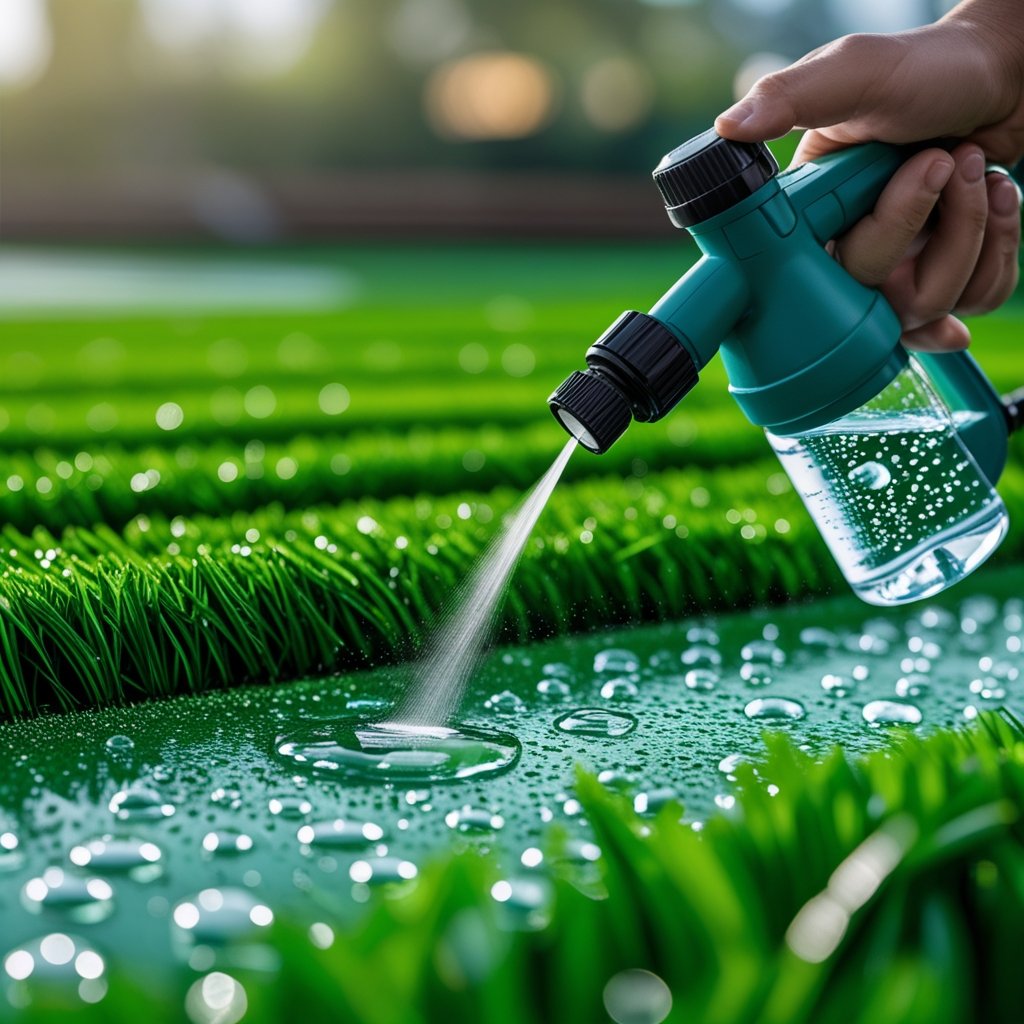
Professional enzyme treatment begins with surface preparation. The turf is cleared of debris and lightly rinsed to moisten the infill. This pre-wetting helps the enzyme solution distribute evenly through the infill rather than channeling through dry spots. The enzyme solution is then applied using calibrated sprayers that deliver consistent coverage at the required volume per square foot.
After application, the solution needs contact time to work. Depending on the product and the severity of the odor problem, this ranges from two to twelve hours. During contact time, enzymes are actively breaking down waste compounds throughout the infill depth. After the contact period, the turf is rinsed to flush away reaction byproducts.
Effectiveness and Frequency
A single professional enzyme treatment can reduce urine odor by 80 to 95 percent when applied correctly to a moderately affected surface. Severe accumulation may require two or three treatments spaced one to two weeks apart for complete elimination. Once the existing buildup is cleared, regular maintenance treatments every six to eight weeks prevent reaccumulation.
Enzyme effectiveness is influenced by temperature, moisture, and pH. Moderate temperatures between 60 and 100 degrees support optimal enzyme activity. San Diego's climate is well-suited for enzyme treatments throughout most of the year, making this approach particularly effective for local homeowners.